
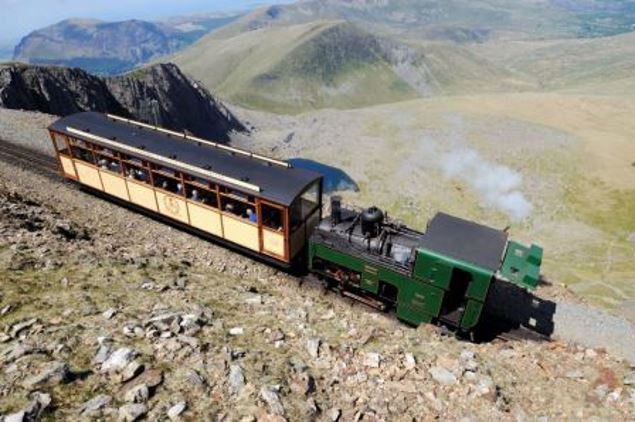
The History of the Snowdon Mountain Railway: A Victorian Engineering Marvel
The Snowdon Mountain Railway first reached the summit of Yr Wyddfa, the Welsh name for Snowdon, in 1896. In fact, 2026 marks its 130th anniversary. The history of the Snowdon Mountain Railway explains why it remains one of the most popular days out in Wales. Victorian engineers built a working railway up the highest peak in England and Wales. Nobody had attempted anything on this scale before. Swiss locomotive builders played a key role. So did a rack and pinion system found nowhere else in the UK. As a result, a fleet of steam engines still climbs the mountain today. Stay at Bryn Bella in Betws-y-Coed. From there, you can reach the railway’s starting point at Llanberis in around 25 minutes.
A Brief History of the Snowdon Mountain Railway
Construction began in December 1894. Around 150 men blasted through solid rock with picks, shovels and dynamite. Then they laid 4.7 miles of track up the mountainside. Gradients reach as steep as 1 in 5.5 in places. However, the average incline works out at roughly 1 in 8 across the whole route. Despite the terrain, the workforce finished the line in just fourteen months. The railway opened officially on 6 April 1896. It cost £63,800 to build: a genuinely enormous sum in Victorian money. That single achievement turned a remote Welsh mountainside into one of Britain’s earliest tourist attractions. In fact, it did so decades before mass tourism reached anywhere else in Wales.
Swiss Engineering and Britain’s Only Rack Railway
No ordinary train could climb a gradient this steep safely. So the railway’s engineers turned to Switzerland for a solution. They installed the Abt rack and pinion system, invented in 1885 by the Swiss engineer Dr Roman Abt. A toothed rack rail runs between the two normal rails. A cog wheel under each locomotive engages with it. This gives the train the grip it needs to climb without slipping. It also provides the braking power needed for a safe descent. The system worked so well that nobody has ever needed to replace it. As a result, the Snowdon Mountain Railway remains the only public rack and pinion railway in the United Kingdom. That makes it a genuine one of a kind attraction on your doorstep from Betws-y-Coed.
The Locomotives That Have Carried Passengers for 130 Years
The Swiss Locomotive and Machine Works in Winterthur built the railway’s first five steam locomotives in 1895 and 1896. Workers named them L.A.D.A.S, Enid, Wyddfa, Snowdon and Moel Siabod. Enid took her name from Enid Assheton-Smith, who cut the first sod of earth back in December 1894. Three more Swiss-built engines then joined the fleet in 1922 and 1923. That brought the total to eight steam locomotives across the railway’s history. Only three steam locomotives remain in regular service today. Two of them date back to that original 1895 batch. In other words, these are genuinely Victorian machines still hauling passengers up the mountain 130 years later. Modern diesel locomotives and railcars, introduced from 1986 onwards, now handle most of the daily timetable. Meanwhile, steam has become a premium heritage experience, running on selected dates through the season rather than every day.
Riding to the Summit Today
A return trip to the summit takes around two and a half hours in total. That includes a thirty minute stop at Hafod Eryri, the visitor centre at the top. Hafod Eryri opened in 2009. It sits at 1,085 metres above sea level and holds the title of the UK’s highest visitor centre. Grab a coffee, browse the exhibition, then step outside for the view. On an exceptionally clear day, you can in theory see as far as Ireland, Scotland, England and the Isle of Man. Even so, this level of visibility is rare, since it needs a very particular wind direction.
You will also need to choose between diesel and steam when booking. Diesel trains run the standard service on modern railcars and cost less. Steam trains, however, run only on selected dates each summer. They use the older locomotives, so they cost more. Either way, book ahead. Check current times and prices on the railway’s own website, since both change through the season.
Stay Close to the Mountain at Bryn Bella
Bryn Bella sits around 16 miles from Llanberis. That’s a comfortable 25 minute drive along the A5, through the heart of Eryri. An early start is easy on the morning you have booked. Afterwards, you will be back among the trees and the river at Betws-y-Coed in time for dinner. Prefer to save the railway for later in your stay? Then read our guide to riding the Snowdon Mountain Railway from Betws-y-Coed for the full journey experience. It covers the legend behind the summit’s Welsh name too. Ready to plan your trip? Book your stay at Bryn Bella and make the railway’s 130th anniversary year part of your own Eryri adventure.
Frequently Asked Questions about the Snowdon Mountain Railway
How long does a trip on the Snowdon Mountain Railway take?
A return journey to the summit takes around two and a half hours in total. It also includes a thirty minute stop at Hafod Eryri before the train heads back down.
Should I book steam or diesel?
Diesel trains run more often and cost less, using modern railcars for the standard service. Steam trains run on selected dates each summer and cost more. They also use locomotives that date back over a century.
Is the Snowdon Mountain Railway really the only one of its kind in Britain?
Yes, it remains the only public rack and pinion railway in the United Kingdom. In fact, it uses the Abt system that Dr Roman Abt invented in 1885.
How far is the railway from Bryn Bella?
Llanberis, where the railway starts, sits around 16 miles from Bryn Bella. The drive along the A5 through Eryri takes about 25 minutes. Prefer to leave the car behind? Alternatively, the seasonal Snowdon Sherpa S1 bus runs directly between Betws-y-Coed and Llanberis, calling at Pen-y-Pass on the way. In total, the journey takes around 50 minutes.
What will I find at the summit?
Hafod Eryri, the UK’s highest visitor centre, sits at 1,085 metres above sea level. It also offers a café, an exhibition and a viewing platform. On a genuinely clear day, the views stretch far beyond Wales.