10 Fascinating Facts About Snowdonia You Probably Never Knew
Ask most visitors for facts about Snowdonia and you’ll hear about Yr Wyddfa’s height, or the little train that runs to its summit. Look a bit closer, though, and Eryri’s story runs far deeper. It winds through Arthurian legend and Hollywood film crews. It also hides a forgotten pair of rival mountain huts, and a legal quirk that catches out half our walkers. Our doorstep here at Bryn Bella in Betws-y-Coed sits right in the middle of it all. Here are ten genuine facts about Snowdonia worth knowing before your next visit.
The myths and legends woven into the mountains
Long before anyone measured Yr Wyddfa’s height, storytellers were already filling its slopes with giants and kings. According to Welsh legend, King Arthur climbed the mountain to slay the giant Rhitta Gawr. Rhitta had made himself a cloak from the beards of the kings he’d defeated. Afterwards, legend places Arthur’s sword Excalibur back in the water. Llyn Llydaw and Llyn Ogwen both claim it, and both lakes sit a short drive from the guest house.
Further north, the hillfort of Dinas Emrys holds another tale. The boy Myrddin Emrys, later known as Merlin, explained to King Vortigern why his castle kept collapsing. Two dragons, one red and one white, were fighting beneath the foundations. Many people still read the red dragon’s eventual victory as an omen for Wales itself, and it still appears on the national flag today.
Out along the coast, the legend of Cantre’r Gwaelod tells of a fertile lowland kingdom. It once stretched twenty miles into what is now Cardigan Bay, and dykes and sluice gates protected it. One moment of carelessness let the sea flood in for good.
Snowdonia on the silver screen
Long before drone footage made Eryri familiar online, film crews were already borrowing its scenery. Two James Bond films used the national park for their action sequences. From Russia with Love (1963) filmed extensively here. The World Is Not Enough (1999) later used the Cwm Dyli pipeline above Nant Gwynant for one of its set pieces.
More than one crew has built Camelot here, too. First Knight (1995) turned Blaenau Ffestiniog, Trawsfynydd and Harlech into King Arthur’s court. Willow (1988) filmed at Dinorwig Quarry near Llanberis instead. More recently, Lara Croft: Tomb Raider used the shores of Llyn Gwynant, and King Arthur: Legend of the Sword (2017) filmed around Capel Curig, just up the road from us.
The historic facts most visitors never hear
A mountaineer didn’t make the first recorded ascent of Snowdon at all. In 1639, Thomas Johnson, a London apothecary and botanist, climbed to the summit to catalogue its plant life. A local guide led the way, and he had clearly done it before.
By the 1840s, two rival refreshment huts had sprung up at the top. Competing entrepreneurs Morris Williams and John Roberts ran them, each trying to outdo the other as tourist numbers grew. In the 1930s, a concrete building eventually replaced their successors. Clough Williams-Ellis, the architect behind Portmeirion, designed it, but it didn’t age well. Prince Charles reportedly called it “the highest slum in Wales,” and crews finally demolished it in 2006 to make way for today’s Hafod Eryri visitor centre.
Ownership of the mountain is more complicated than most people assume, too. The historic Hafod y Llan farm on Snowdon’s southern slopes passed to the National Trust in 1998. A public appeal raised £4 million for the purchase, and Sir Anthony Hopkins personally donated £1 million as the campaign’s ambassador. UNESCO recognised the wider area’s industrial past more recently still. In July 2021, the Slate Landscape of Northwest Wales became Wales’s fourth UNESCO World Heritage Site.
The quirky rights and laws unique to Eryri
Since November 2023, the Eryri National Park Authority has recorded every one of its hundred-plus lakes by Welsh name only. It has retired familiar English nicknames, such as “Lake Australia” for Llyn Bochlwyd, to safeguard the area’s historic place names for future generations.
Perhaps the biggest surprise for first-time visitors, though, is that wild camping has no automatic legal protection anywhere in Eryri. Dartmoor has long carried a specific right like this, but Eryri doesn’t. Every acre of the national park technically requires the landowner or farmer’s permission first. A pitched tent on the hillside might look common in midsummer, but that doesn’t make it legal.
Bring the legends home with you
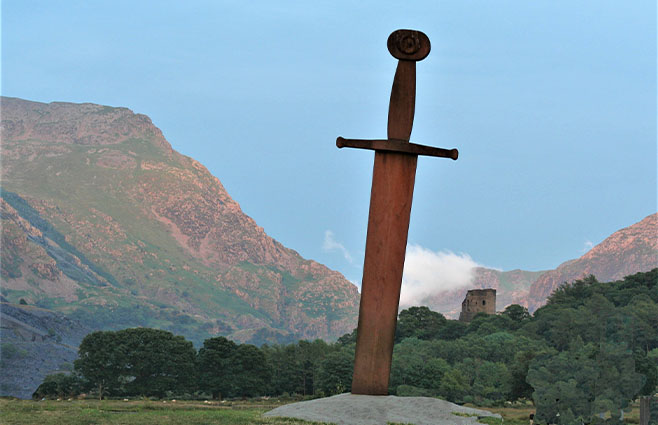
Knowing the stories behind Eryri makes exploring it far richer. You might stand at Llyn Padarn beside the Blade of the Giants sword sculpture. Or you might trace Bond’s footsteps along the Cwm Dyli pipeline, or simply wonder which lake hides Excalibur. If you’d like to base your trip somewhere quiet, comfortable and close to all of it, book your stay at Bryn Bella. We’ll happily point you towards the routes and viewpoints that fit each of these stories. For more ideas on filling your days here, take a look at our guide to things to do in Betws-y-Coed. Or get in touch if you’d rather we plan it with you.
Frequently asked questions
Is Snowdonia still called Snowdonia?
The national park’s official name changed to Eryri National Park in 2022. Snowdon itself now officially goes by Yr Wyddfa, though most people still understand and use both English names.
Can you wild camp in Snowdonia?
Not without permission. Eryri National Park Authority makes clear that you need landowner or farmer consent everywhere in the park. It’s worth asking locally or booking a campsite rather than assuming it’s allowed.
Where can I see the giant sword sculpture from Snowdonia’s legends?
The Blade of the Giants stands on the shore of Llyn Padarn at Llanberis, close to Dolbadarn Castle, roughly a twenty-minute drive from Bryn Bella.
What films have been shot in Snowdonia?
Recent and classic productions include two James Bond films, First Knight, Willow, Lara Croft: Tomb Raider and King Arthur: Legend of the Sword. Many of them used locations within easy reach of Betws-y-Coed.
Who actually owns Snowdon?
No single body owns the whole mountain. The National Trust’s Hafod y Llan estate, Eryri National Park Authority and other private landowners all share its slopes.